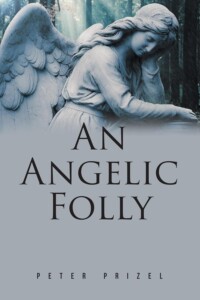
Title: An Angelic Folly
Author: Peter Prizel
Publisher: Peter Prizel
ISBN: 9798339578673
Pages: 150
Genre: Spiritual
Reviewer: Rae Capri
Pacific Book Review
 In An Angelic Folly, author Peter Prizel introduces readers to Jacob Monger, a social worker working at the Hospice of Orange and Sullivan Counties in Newburg, New York. His interactions with the patients all seemed sincere and genuine to the point that each one left a lasting impression on his heart. Tony Smith, one of the elder patients, a veteran of Vietnam, who suffered from stage four prostate cancer, ended up being one of the main characters, as we learned more about his life. The greatest regret he was burdened by was not knowing whether or not he fathered any children. He considered and then submitted a DNA sample for evaluation by 23AndMe, in hopes of leaving the Earth knowing the results. Agent Orange has played a role during his many attempts to sow his oats, and he figured that, because of no successful pregnancies, children were not going to be part of his life’s journey. One could find this admirable for him, taking his final opportunity to send up a prayer for each of his children and ask forgiveness for his absence in their lives.
Being a social worker in hospice can take an emotional toll on an individual, as many patients die alone without family or friends. To step in as a support system during a patient’s final days is more than appreciated; it’s a genuine connection amongst fellow men when they are most vulnerable. Dying can be a scary experience because of the unknown, as far as what happens after you close your eyes for eternal rest. Death is never an easy thing to deal with, especially when your time here on Earth is winding down, something everyone will experience in due time. For everyone’s best interest, handle all affairs in making the transition a smooth experience for all of those involved. Clear the air of all negativity and friction towards those you love and who love you. Ask for forgiveness of any wrongdoings, and atone for sins, but this should be done long before you leave this world.
The encounter Jacob had with various characters, all of whom shared the same characteristic of heterochromatic eyes, led him to meet Gabriel, the Archangel. Gabriel was assigned the responsibility for the souls entering purgatory, all while driving Harriet, the Biblical chariot. The hospice Jacob worked at was best suited for various reasons. The few patients they had fit the requirements Gabriel needed: men who fathered children. Harriet needed to be fully drivable based on the condition of the wheels that carried her. New souls that have passed on are what helped keep the chariot running smoothly.
In the end, what stood out the most was Gabriel needing to have an audience with our Heavenly Father and apologize for the incident and misunderstandings he committed 5000 years ago. One that involved the gates of Heaven being ajar, and Lucifer escaped. Definitely something that seems unforgivable, that is, until asked for forgiveness. The interaction of a human pep talking to an archangel to have that conversation with God, demonstrates that we are all God’s children, regardless. Experiencing the interaction between Jacob and Gabriel seemed more like brothers bickering or disagreeing on talking to their parents about an issue. It took Jacob a bit to convince Gabriel, assuming he is a bit stubborn in that sense, but it ended up working out. Being rewarded by God is a beautiful thing; it shows you how much He loves and wants the best for us.
The reading experience of this book has been a pleasant one. I found myself laughing during some interactions between characters, while feeling emotions for those who passed. Working in the field where death is inevitable can be very tough to navigate, and I commend those who took on this role. Through this story, one realizes that all things can be forgiven by God, as long as you approach with the intention in your heart to apologize. It is not too late, but waiting until the end could be deemed as too late. Of course, we human beings are created to be imperfect, yet we should still strive to be better and do better for ourselves. Let us not forget Jacob playing Mozart’s Requiem on repeat on his phonograph, which puts life into perspective because the song invokes sadness. The history behind this famous composition proves that originality gives inspiration to the newer generations. Even though the song is sad to listen to, the words, when translated, are of deep thought.
I highly recommend this book to others, as it is a short read but provides so much biblical value. It gives a friendly reminder that life is precious, loved ones are important to hold dear, and your faith is what matters when it is all said and done, when you are to stand before God when your time is up. Thought-provoking and poetic, this book challenges us to see the divine in all its fragile humanity.