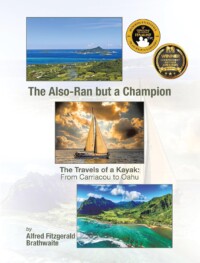
Title: The Also-Ran: But a Champion: The Travels of a Kayak: From Carriacou to Oahu
Author: Alfred Fitzgerald Brathwaite
Publisher: AuthorHouse
ISBN: 979-8823006477
Pages: 526
Genre: Biography / Parenting & Relationships
Reviewer: Lily Amanda
Read Book Review
Pacific Book Review
Some stories are loud and dramatic, but then there are others that quietly unfold across islands, cities, and decades. Ever heard of someone from a poor background rising from the ashes to travel the world, earn a medical degree, and live a life rich in experience, culture, and quiet victories? The Also-Ran: But a Champion: The Travels of a Kayak: From Carriacou to Oahu is that kind of story. It set sail on the tiny Caribbean Island of Carriacou in 1941 and unfolds across diverse regions, showing how an ordinary life can become extraordinary in its own way.
The Also-Ran: But a Champion: The Travels of a Kayak: From Carriacou to Oahu is a rich and deeply reflective memoir that chronicles Alfred Fitzgerald Brathwaite’s life journey from his humble beginnings on the Caribbean Island of Carriacou where he was born in 1941 to a life of global exploration, professional achievement, and cultural immersion which span several countries and regions. The book is divided into four parts namely, The Early Days of Old in the Present which covers Brathwaite’s childhood and adolescence in Carriacou, including family life, schooling, and local customs, Extended Medical Training—with a Salary which follows his academic and medical training in Jamaica, the Bahamas, and Canada, An Independent Working Man which recounts his professional life as a doctor in places like Grenada, Suriname, and the Bahamas and The Revolving Door: A Time to Go, which includes reflections on returning home, poetry, personal philosophies, and final musings.
Brathwaite grew up in a small rural village in a modest wooden home which he shared with his siblings. Their home was surrounded by hills, gardens, and the kind of family traditions that gave everyday life its rhythm and meaning. His childhood was shaped by strong family values, a deep Christian faith, and a deep respect for education even though there wasn’t much in terms of material wealth. At the center of it all he tells of his mother, who wisely guided him with steady love, instilling in him a strong sense of right and wrong which shaped not just his character but also the way he approached decisions throughout his life.
Brathwaite’s tide began to turn when he left Carriacou at age 11 to attend school on the mainland of Grenada. This was a move that would mark his first real step away from the close-knit routines, natural beauty, and humble lifestyle of island life. Although it was his first time navigating life beyond his village, the real shift however came when he gained admission to the University of the West Indies, Mona Campus in Jamaica in 1961, to study medicine. That transition would open up his world socially, intellectually, and professionally like he had never experienced before, even as he came face-to-face with new cultures and ideas as well as people who would deeply challenge and inspire him. It was there that his identity quietly began to shift, from a boy with humble beginnings and big hopes to a student becoming a doctor, and ultimately, someone who could move through the world with confidence, curiosity, and a deeper sense of purpose.
More than just an ordinary memoir, this is a deeply personal account of a life shaped by hardship, movement, culture, and quiet triumph, and a story that deeply speaks to what it means to step outside the familiar and take a chance on something bigger. It also proves that without privilege or connections a person can still carve out a life that reaches far beyond what they were born into. The book also reflects a deep internal journey not just about what the author did but also how each place, person, and challenge helped him figure out who he was.
The Also-Ran: But a Champion: The Travels of a Kayak: From Carriacou to Oahu by Alfred Fitzgerald Brathwaite is one of the most vivid memoirs out there that accurately capture the rhythms, struggles, and beauty of Caribbean life and what it means to carry that identity into places like Jamaica, Canada, Suriname, and the Bahamas. It beautifully explores how people adapt while still holding onto cultural roots. Its tone is nostalgic and introspective, and its title itself redefines success. It is a must read that will definitely speak to anyone who appreciates life stories rooted in hardship, resilience, and quiet transformation, as well as those reflecting on identity, legacy, and where they truly belong. It quietly insists that being an “also-ran” doesn’t mean being forgotten but showing up, enduring, and, in your own way, becoming a champion.