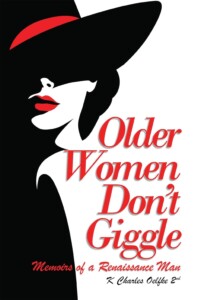
Title: Older Women Don’t Giggle: Memoirs of a Renaissance Man
Author: K. Charles Oelfke II
Publisher: The Reading Glass Books
ISBN: 979-8894791944
Pages: 179
Genre: Literary Memoir
Reviewer: Gabriella Harrison
Pacific Book Review
Author K. Charles Oelfke II has written an unconventional memoir, Older Women Don’t Giggle: Memoirs of a Renaissance Man, that follows an episodic-style in sharing his cultural reflections gained from years of traveling while also capturing his romantic and emotional awakening through a relationship with an older French woman, who he describes as a femme d’un certain âge (“a woman of indeterminate age who can be sophisticated and attractive”).
When he received a Fulbright Grant to study industrial design in Paris, he arrived in France as an ambitious, culturally curious, and romantically inexperienced young man. Fascinated with French culture, he quickly became immersed in Parisian social life, participating in café gatherings, social dinners, museum visits, design circles, and intellectual conversations within artistic and expatriate communities. These cultural and social settings provided the avenue through which he met the older French woman he describes as emotionally mature and cultured. Indeed, their relationship was sensual but also philosophical, and he terms this his first experience of genuine emotional intimacy and adult romantic depth.
Amid this, he also recounts the time he spent working within the orbit of and observing the professional world of famed industrial designer Raymond Loewy. Loewy serves as a contrast between American commercial design and European aesthetic philosophy, while providing insight into professional pressure experienced in the industry.
Throughout, Oelfke reflects on French attitudes toward aging and female autonomy, frequently contrasting American and French cultural norms. Sometimes thoughtfully, and at other times simplistically and generalized. Through long, measured sentences and thoughtful pacing, Oelfke conveys nostalgia, “I did not know then how much that year would shape the rest of my life.” This sentence carries the retrospective awareness that is evident in much of the book. As is expected, that as one becomes older, they gain perspective and interpretive clarity, such is the case here, as he provides a dual-time perspective balancing his years as a young man against his matured voice, adding insight to youthful experiences through retrospective first-person narration and reflective commentary layered over memory. In his older years, he frequently contextualizes youthful assumptions, acknowledging naiveté while also preserving the emotional intensity of that formative year.
Charles Oelfke II’s memoir Older Women Don’t Giggle is ultimately more about formation artistically, culturally and emotionally than romance. Indeed, the book’s title evolves into a metaphor for dignity rather than age, underscoring the memoir’s quiet argument about maturity and refinement. Witty, stylish, and unapologetically honest, this memoir proves that experience isn’t just attractive, it’s magnetic.