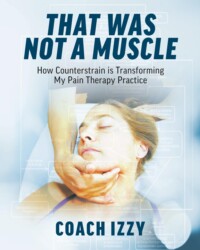
Title: That Was Not A Muscle: How Counterstrain is Transforming My Pain Therapy Practice
Author: Izzy Sanchez
Publisher: Mar en Hoguera Media
ISBN: 978-0983566144
Pages: 168
Genre: Nonfiction / Health / Mind & Body Reference
Reviewer: Tony Espinoza
Author Interview questions – Izzy Sanchez
Today, Pacific Book reviewer Tony Espinoza is talking with Izzy Sanchez, author of “That Was Not A Muscle: How Counterstrain is Transforming My Pain Therapy Practice.”

PBR: What inspired you to write That Was Not A Muscle: How Counterstrain is Transforming My Pain Therapy Practice?
There’s no greater driver than the need to scratch our own itch. In my case, there was a need for a guide that could summarize the many layers governing the application of Fascial Counterstrain, and this needed to be done in a way that could be understood by our clients who, while not necessarily researchers, are health-conscious readers.
PBR: The title is intriguing. Can you explain the meaning behind “That Was Not A Muscle” and how it relates to your journey as a pain therapist?
It’s a homage to my meeting with Tim Hodges—the founder and director of the Counterstrain academy—in the late summer of 2011, after Tim resolved one of my most frustrating cases in only one session. Back then, my realm was deep tissue therapy and I only had a vague idea of what Counterstrain entailed. When I asked Tim what muscle he had worked to resolve the case, he mentioned that the structure he had worked on had been a vascular structure, not a muscle. The meeting opened my eyes to new horizons and was pivotal in my career.
PBR: For readers who may be unfamiliar with Counterstrain therapy, what exactly is it, and how does it differ from traditional pain treatment methods?
Counterstrain is a complex process that drains trapped inflammation from the microvasculature in the interstitium. What makes it different is that we understand that many of the physiological phenomena considered causal—such as tightness, knots, pains, imbalances, etc.—are only expressions of the protective reflex arcs driven by this trapped inflammation. Our methods help us identify in which physiological system, and in which part of the physiological system, this inflammation is trapped so we can drain it.
PBR: Was there a specific patient experience or breakthrough moment that convinced you of Counterstrain’s effectiveness?
It took place the day after I completed my first ever Counterstrain course. I had been working on a client who couldn’t lie flat on his back after a surgical procedure. Prior to the class, I had worked on him for a few sessions with limited success. Counterstrain took care of the problem immediately and I knew then that it’d become an essential part of my practice.
PBR: How has Counterstrain transformed your professional practice and your approach to treating chronic pain?
Counterstrain provides us with a perspective that, while congruent with our physiological functions, defies convention, which in turn helps us find solutions where others find only stumbling blocks. For instance, many women dealing with years of back pain are told that their issues are psychosomatic because imaging studies can’t find an evident cause. It’s not uncommon for the Counterstrain therapist to bring relief to these cases by draining inflammation trapped in the scar tissue of their C-sections, or in their sacral mesentery affected by hormonal fluctuations. We acknowledge the symptoms but don’t treat them directly because we know they’re expressions of aberrant protective mechanisms, and they will resolve once we drain the trapped inflammation.
PBR: What are some of the most common misconceptions people have about pain and its causes?
The biggest misconception is that pains and/or dysfunctions are the product of musculoskeletal imbalances and can be resolved via exercise. Exercise is a significant component in the healing journey but not the priority when the body is engaged in anomalous protective mechanisms. Most people are not acquainted with the guarding mechanisms affecting alpha and gamma motor neurons, which produce muscular hypertonicity or reduced range of motion and weakness. Exercises and stretches won’t be effective because they’re trying to counter a reflexive response.
PBR: In your experience, why do so many patients struggle to find lasting relief through conventional treatments?
Because most conventional methods confuse the pain or the symptoms with the dysfunction. Many painful areas that were never injured do not respond to treatment because they’re only a byproduct of trapped inflammation on neural convergence. Many of the aggressive techniques that people use to find relief numb the pain temporarily but do not address the pain-driving mechanism. The heavy musculoskeletal bias still dominant in conventional therapy limits treatment to one physiological realm, which in complex cases is rarely where the drivers are.
PBR: How do you envision the future of pain management and manual therapy?
Brian Tuckey—the creator of the Fascial Counterstrain System—published his breakthrough paper about our theoretical rationale in August of 2021. Month after month, other researchers are starting to see the strength of his hypothesis and citing his work. It’s encouraging to see more pain-oriented professionals exploring the role of inflammation in overall health, and how it can be addressed via manual therapy. Counterstrain has challenged what we’ve accepted manual therapy should be, and more modalities are acknowledging that our bodies do not need to be subjugated to aggressive treatments to find relief.
PBR: What advice would you give to healthcare practitioners who are interested in learning more about Counterstrain?
I hope this book inspires you to explore this incredible field. There’s no more frustrating feeling to a therapist than the inability to help our clients despite our best efforts, and Counterstrain is what saved me from this pit. Counterstrain mastery demands exploration, introspection, and growth, and gives you in return an incredible set skills that changes lives. You will make a difference where others have failed, and though you will explain the science to your clients, they’ll be convinced that what you do is nothing short of a miracle, and you won’t be able to convince them otherwise.
PBR: For readers currently living with chronic pain, what message of hope would you like to share?
What drove me into Counterstrain was the frustration of not being able to help those who sought my expertise. All my colleagues share similar stories. We all study and practice to be able to identify and drain the areas of trapped inflammation driving so many of your symptoms. Provided that you do your part in the healing journey, there’s a lot that Counterstrain can do to help you enjoy life again. We look forward to welcoming you to our practices and you’re the force that motivates us to keep improving.