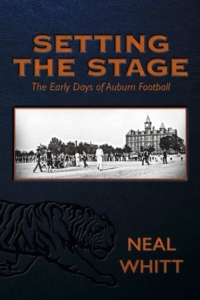
Title: Setting the Stage: The Early Days of Auburn Football
Author: Neal Whitt
Publisher: BookBaby
ISBN: 978-1-6678-6375-7
Pages: 368
Genre: Historical & Sports
Reviewer: Jason Lulos
Pacific Book Review
In the south, college football has rich and nostalgic traditions. With Setting the Stage, author Neal Whitt gives us the fascinating history of Auburn football but focuses on its humble beginnings. He chronicles the early struggles of fielding and funding a team. Whitt’s rendering of the story is captivating because of his attention to detail but also because he captures the start of what would become an almost mythological tradition of athletics, higher learning, and some of the most ardent fans in the country.
The book opens with descriptions of a picturesque landscape of a modern-day Auburn game. Then Whitt turns to the past. Auburn was established in 1856 but closed during the Civil War to become a hospital for Confederate soldiers. The university reopened and began their first intercollegiate football team in 1892 under head coach George Petrie, a professor of history and Latin. Petrie and the early coaches and supporters of Auburn football seemed to have a vision that college football would become a national pastime and that it would rally students and local citizens to root for their team with an almost religious fervor. That vision was correct and Setting the Stage is Auburn’s story of that vision.
Another early coach was none other than John Heisman, who led the team from 1895-1899. Heisman stressed team unity and worked his players to the bone so they would be able to outlast any opponent. And he hated to lose. He designed offenses to spread the field with double reverses, established the hurry-up offense, and used whatever he could to gain an advantage: i.e., the “hidden ball trick.” He was also instrumental in legalizing the forward pass. Heisman put the team above any one player. Thus, he was against having an award dedicated to the most valuable player. However, in 1936, a year after his passing, the Heisman Award was established to honor the nation’s best player.
All of Auburn’s early coaches believed that academics were as, if not more, important than athletics. They believed in honesty, hard work, and honoring their alma mater. This tone did indeed set the stage for a sports tradition steeped in these values. As romanticized as college football has become, this early period was not without hardship. Teams had trouble funding their teams. Detractors tried to ban football because it was too violent. But those that supported this new sport in its early days believed it would become a long and loyal tradition. Whitt beautifully captures this notion by showing that vision of camaraderie among players and the unity of fans with their team: perhaps a necessary communal endeavor in the aftermath of the Civil War.
College football and Auburn fans will love this book. For those uninterested in football, it is still a great read. This is not just a story about what it took to get college football going. It’s about the romance of the sport, its connection to university life, and as a burgeoning national pastime. A love letter to Auburn and college football. It will especially appeal to those who appreciate the stories behind the teams, players, and formative moments that helped shape college football history.