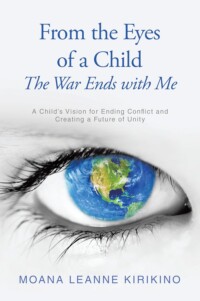
Title: From the Eyes of a Child The War Ends with Me: A Child’s Vision for Ending Conflict and Creating a Future of Unity
Author: Moana Leanne Kirikino
Publisher: BalboaPressAU
ISBN: 9798765203453
Pages: 60
Genre: Inspirational / Non-Fiction
Reviewer: Susan Brown
Pacific Book Review
“War ends not with weapons but with love, remembrance and the bravery to listen.” Author Moana Leanne Kirikino makes the case in her book that these three convictions are the steps to finding peace, both in our public and private realms. The key to accessing these characteristics is by reengaging with our inner child; to tap into the natural innocence distinctive to childhood.
Ms. Kirikino brings her experience as a mother, foster parent and spiritual guide to this narrative and has written multiple books on healing, transformation, awakening, wholeness and love. She is an inspiring writer, reminding us “to remember our shared truth and to begin healing the world one heart at a time.” And she gives us permission to take this on at our own pace and in our own way. She writes, “You don’t have to save the whole world. Just don’t be the reason it needs saving.”
This book is powerful in its simplicity. Although the author tackles a complex subject matter, brokering peace in a violent world, she is able to encourage understanding of her message through inspired writing that breaks down difficult issues in a straightforward and uncomplicated manner. Additionally, she uses a variety of methods that prod the reader to see the world through the eyes of a child. At the end of each chapter there are suggestions in the form of either a reflection prompt, inner practice, gentle practice or a simple promise which can be used both for contemplation and action,
Ms. Kirikino speaks directly to readers, calling on each of us to ask ourselves, “Do you remember what it felt like to be a child? Would that child be proud of who you are now?” Two self-reflective questions that challenge us to look deeply at what’s in our hearts and “rewrite” our story and take “one small step towards that vision,” if necessary,
I was particularly drawn to her perspective that, “We are meant to share this planet, not conquer it,” that “the natural world thrives in balances — and we can too.” As I read that, it brought up memories of me sitting in my grandfather’s garden, watching him weave together a place of interconnected peace and quiet through a symmetry of plants. That memory, is the type the author is encouraging the reader to be mindful of, brought with it a moment of peacefulness that was incredibly welcome; an affirmation of Ms. Kirikino’s message about remembering what it was like to be a child.
She also provides examples in two chapters to be used to write letters, one to humanity that calls us to “stop pretending we’re separate” and to “start acting like a family again,” and the other to world leaders, emphasizing that we should “stop hurting one another.” That childlike innocence may leave us as we transition out of childhood, but the author makes the case, with a little work we can, and must try to recapture the spirit of that time. A task well-worthy of all our efforts. This inspiring book is a beacon for dreamers, peacemakers, and anyone who believes in the power of love to reshape our shared future.