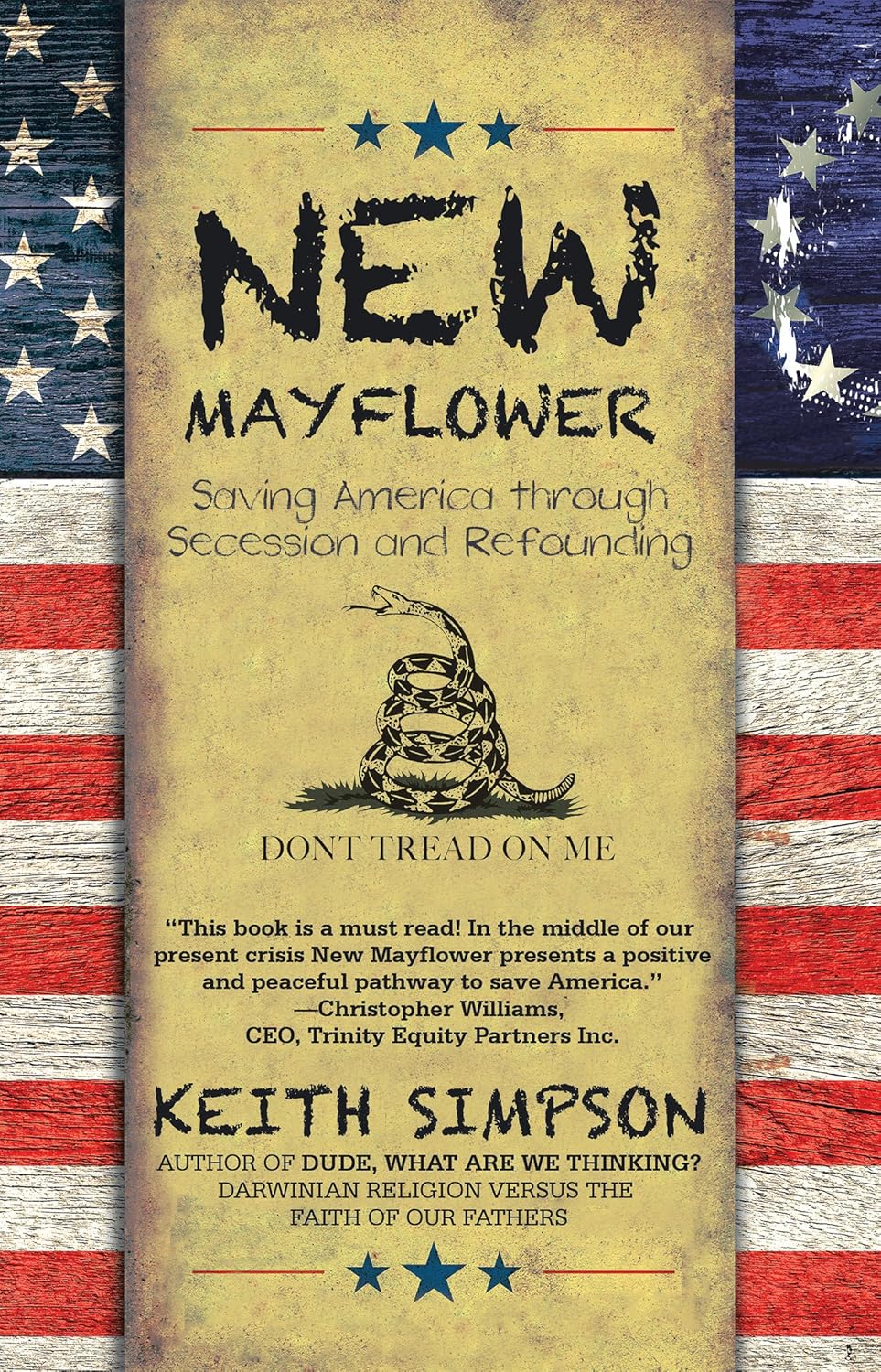
Title: New Mayflower: Saving America through Secession and Refounding
Author: Keith Simpson
Publisher: iUniverse
ISBN: 978-1-5320-1162-7
Pages: 206
Genre: Political Science
Reviewer: Jason Lulos
Pacific Book Review
 Political polarization is palpable. The notion that there are “two Americas” has been espoused by pundits on the left and the right. In New Mayflower, author Keith Simpson argues that we must face this sad reality. His supposition is that secession, while seemingly drastic, is in fact a very American path to take because it holds with the Declaration of Independence and the Constitution. This book is an intriguing treatise on fixing the problem of two Americas by formally establishing a second new America state by state.
Simpson argues that the progressive revolution in America has taken us from traditional Judeo-Christian values to cultural relativism and dependency on central government. One may not agree with his political philosophy or believe that secession is logistically possible. Refreshingly, he does not think all republicans are bad and all democrats are good. This kept me reading. He notes: “It’s not that progressives are bad people or that conservatives are good people. For all kinds of reasons, good and noble people fight on opposing sides of war. Life is confusing. Sometimes it’s hard to know what to believe or how ideas will play out. Progressives and conservatives each believe they are doing the right thing. In this conflict, we are fighting brother against brother. We bear no malice.” (89)
The book is in four parts. In “American Identity,” Simpson celebrates the Pilgrims, the Founding Fathers, and the determined spirit of early settlers and colonialists. In “Identity Lost,” he presents a systematic argument tracing the evolution of progressivism from the Enlightenment to the present day. Citing Nietzsche and others, Simpson outlines what he sees as a gradual turn from God and self-reliance toward a culture of secular humanism and general dependency on central government. In New Reality he suggests this progressive evolution has become propagandized through movies, literature, and media. He argues this progressive shift has been a Darwinian-based campaign: progressives use the Darwinian ideas of continuous change in an indifferent universe as being in line with their arguments for continuous social change, irrespective of God or spirituality, and thus, abandoning the very idea of universal, or unchanging truths which, Simpson argues, are central to the original and ideal concept of America.
His further arguments are as follows. Political and economic developments have shifted from self-reliance and spiritual authority toward human-centered and thus self-centered notions of identity. Cultural relativism has resulted in corrupt and morally gray federal judges. He argues that the increase of welfare programs is justified by caring for the poor but adds that this just incentivizes dependency on the government and impedes upward mobility. In short, he argues that America has devolved from a can-do Christianity-based ethos to a cultural identity of an ever-changing, thus Darwinian cultural relativism that shifts individual authority to the authority of the federal government.
In the final section, “New Mayflower Strategy,” (NMS) he lays out a systematic plan for peaceful secession. This is obviously a republican or conservative secession from the United States. The new America would be called the CSA or the Constitutional States of America. Simpson proposes a series of amendments that would accompany a successful NMS vote for secession. Some of these include an elimination of income tax and a restoration of freedom of religion and speech. This is to be done on a state-by-state basis.
New Mayflower is methodical and organized but is sure to be controversial. Perhaps, it is too partisan and not logistically feasible. And perhaps its suggestion that the political polarization of America is irrevocable prematurely accepts our political division. Regardless of one’s political leanings, it is a thought-provoking idea that presents a most radical solution. Grounded in historical parallels yet sharply contemporary, this book offers a powerful reimagining of America’s next great chapter. This book is certain to push the boundaries of political conversation in America.