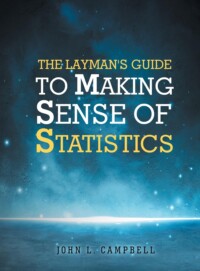
Title: The Layman’s Guide To Making Sense Of Statistics
Author: John L. Campbell
Publisher: Kravitz and Sons LLC.
ISBN: 979-8-89639-251-4
Pages: 76
Genre: Educational
Reviewed by: Subhrajit Saha
Pacific Book Review
Statistics have always been a confusing world to the people who are unaware of the subject. People always thought it is as tough as mathematics, so they might ignore or keep a distance with this number game. But there are always some people who love adventure, who find it fun solving puzzles and playing with numbers and the author John L. Campbell is definitely one of them. His educational title The Layman’s Guide To Making Sense Of Statistics introduces the laymen with the magical universe of statistics. The book makes us aware of how with centuries Statistics helped the civilizations or societies to grow, to evolve, and to be a better one for mankind. Starting with the historical events and digging up the early days of the subject, to its evolution and application is at the center of Campbell’s title. There are indeed a few detailed discussions and technicalities about the subject which will make the students of Statistics, but it is still illustrated in a much simpler way that everyone could get the main message. In the end of the book, your fear regarding the subject will not only vanish, rather you might feel the urge to dive deeper with it.
The Layman’s Guide To Making Sense Of Statistics can be divided into two parts as per the topic of the book. The very first part is an interesting introduction about the subject, including what is Statistics? How it evolved over the years, how it became a profession? How it helped societies to grow and so on. On the other hand, the other part of the book concentrates on topics like its divisions, attributes such as dispersion, correlation, frequencies, averages, etc.
Somebody not interested in the subject or ignored it for years will get hooked by knowing how it took thousands of years to take shape like it is in today’s time. Instances like Statistics took shape in the year 1835 and later in 1890 it became a part of Mathematics. Along with that, statistics help the governing bodies to know about its population, people engaged in particular kinds of occupation, people’s needs, etc., which later contributes to maintaining a sustainable and healthy state on a long term basis. Things look more fascinating getting to know how Europeans used the census for their political and economic growth.
In the later part of the book author Campbell provided knowledge about the core and as well showed a detailed anatomy of the evolution of modern-day statistics from the ancient times. There are introductions about very known tests like Man Whitney U test, Median test, Wilcoxon signed rank test or a rigorous briefing on the linkage of proportion and percentage with correlation, or its relationship with regression. There are introductions of characteristics like dichotomies, history of the extinction of bivariate and multivariate taking the front seat and so on. In the book The Layman’s Guide To Making Sense Of Statistics you will get to know about a fascinating numerical world if you are inquisitive about exploring every aspect of life.It is intriguing from a layman’s perspective, along with that if you are an expert on the subject then Campbell’s book contains a lot to offer you. In the end of everything, the book is engaging, interesting, and obviously a bit fascinating as well. Whether you’re a student struggling with stats or a lifelong learner trying to keep up with data in the news, The Layman’s Guide to Making Sense of Statistics is the clear, no-fluff guide you’ve been looking for.