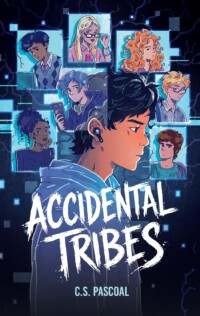
Title: Accidental Tribes
Author: C.S. Pascoal
Publisher: Prospera Books
ISBN: 979-8995829829
Pages: 203
Genre: Teen & Young Adult Detective Story
Interviewed By: Anthony Avina
Author Interview with C.S. Pascoal
 PBR: What inspired you to write Accidental Tribes, and where did the original idea for the story come from?
I entered the tech industry at sixteen, and much of my career has been about understanding how technology changes our lives. Now, as the mother of a fourteen-year-old boy in New York City, those questions are also at my dinner table.
For teenagers, a phone holds friendships, communities, information, status, and dreams. What happens there follows them into classrooms and bedrooms. With Accidental Tribes (accidentaltribes.com), I wanted to explore what it means to grow up in that reality, especially when adults have already decided who you are. That became the starting point: eight kids nobody trusted, brought together in one room everyone forgot.
PBR: The title Accidental Tribes is intriguing. What does the phrase mean within the context of the novel?
We don’t always find our people where we expect to find them. Sometimes belonging begins with someone we would never have chosen to sit beside.
In Accidental Tribes (accidentaltribes.com), eight teenagers from different boroughs, cultures, and social classes are placed together because of their mistakes. The title speaks to what can happen when people look beyond those first judgments. An accidental encounter can become a relationship that changes how you see yourself and others. Readers’ Favorite called the book a “true masterpiece of pure togetherness,” which speaks beautifully to that possibility.
PBR: What drew you to writing a detective story for a young adult audience?
A mystery invites readers to pay attention, question appearances, and decide whom to trust. Those are also things teenagers are learning to do in their own lives.
With Accidental Tribes (accidentaltribes.com), I wanted readers to be absorbed in what happens next while exploring questions about identity, accountability, and belonging. A detective story gives those questions urgency. When something is being hidden, understanding another person can become essential to finding the truth.
PBR: Without giving away any spoilers, can you tell readers a little about the mystery at the heart of the story?
In Accidental Tribes (accidentaltribes.com), eight teenagers at a New York City public school are placed in a thirty-day experiment with serious consequences if they fail. As they get to know one another, they begin uncovering secrets that reach far beyond their own behavior.
An unresolved death on school grounds, missing funds, and adults with reasons to keep things quiet pull them into a mystery they cannot easily walk away from. The challenge is figuring out whom they can trust when they have so little reason to trust one another. The Prairies Book Review described it as “a razor-sharp, wickedly clever mystery for the always-on generation.”
PBR: What can you tell us about your main character and what makes them an interesting protagonist for young readers?
Accidental Tribes (accidentaltribes.com) has an ensemble of eight teenagers rather than one central protagonist. Each brings a different perspective, and each has something the others initially misunderstand.
One might be judged for hacking grades, another for creating an online humiliation, and another for withdrawing into grief. Their actions have consequences, and those actions don’t tell their whole stories. I hope young readers recognize that tension: wanting to be understood while still having to take responsibility for what you have done.
PBR: What challenges did you face when balancing the darker or more serious elements of a detective story with the perspective of a young adult audience?
The challenge in writing Accidental Tribes (accidentaltribes.com) was giving difficult experiences their proper weight while leaving room for humor, friendship, and possibility. Teenagers can move from a joke to a deeply serious conversation in seconds. I wanted the story to make room for that range.
Teen readers helped shape the book by reading every arc and telling me what I got right, wrong, and badly wrong. I opened myself to their criticism. Their responses helped me understand where a moment felt honest and where an adult’s assumptions were getting in the way.
PBR: Were there any real-world issues, experiences, or observations that influenced the themes explored in Accidental Tribes?
Absolutely. My work in technology, my experience as a parent, and my involvement in public and private school communities all informed Accidental Tribes (accidentaltribes.com).
I’m interested in how quickly we label teenagers without understanding the pressures around them. We ask them to manage distraction, comparison, and public judgment while adults around them are struggling with tech addiction themselves.
“Teens aren’t broken. The rules are hidden” captures a question at the heart of the story: how can young people navigate a world whose expectations are constantly changing, often without anyone explaining them? The Children’s Book Review described the book as “fast-paced and compelling, perfect for teens who want fiction grounded in the realities of the twenty-first century.”
PBR: What advice would you offer aspiring young writers who dream of creating their own mystery or detective stories?
Start with something you are curious about. What would make someone hide the truth? What could they lose if it came out? Those questions help you build both the mystery and the people inside it.
Writing Accidental Tribes (accidentaltribes.com) reinforced how valuable honest feedback can be. Know what actually happened, even if your readers won’t discover it until much later. Give them clues they can look back on and recognize. Read your dialogue aloud, and invite feedback from people who will tell you when something doesn’t make sense. You don’t have to get everything right in the first draft. Give yourself something you can revise.
PBR: Do you have plans to revisit these characters or develop Accidental Tribes into a series?
I can see possibilities for revisiting the characters in Accidental Tribes (accidentaltribes.com). There is more to explore in their relationships and in the choices they make as they grow.
Any continuation would need a story worth telling, with new questions and meaningful consequences. For now, I want readers to discover this book and spend time with the people at its heart.
PBR: Finally, what would you most like readers to know before they pick up Accidental Tribes?
Come for the mystery, and give these teenagers a chance to surprise you. They make mistakes, hurt one another, laugh at awkward moments, and discover that accepting help can take courage.
I wrote Accidental Tribes (accidentaltribes.com) for teens and the adults around them. I hope it opens conversations that can be difficult to begin at home or in a classroom. Reading descriptions such as Readers’ Favorite’s “true masterpiece of pure togetherness” has been deeply meaningful because connection is at the heart of the book. Above all, I hope readers leave with a little more curiosity about the people they think they have already figured out.