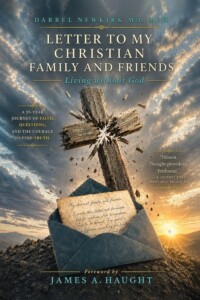
Title: Letter to My Christian Family and Friends: Living Without God
Author: Darrel Newkirk
Publisher: Ewings Publishing LLC
ISBN: 979-8903014217
Pages: 162
Genre: Memoir / Religious
Reviewer: Susan Brown
Pacific Book Review
For a man who spent the better part of his life as an active member of the Southern Baptist Church, this book makes quite a statement. Mr. Newkirk does a truly thoughtful job explaining the transformation that transpired to move him out of the nonsecular realm and into the secular. Letter to My Christian Family and Friends encapsulates the author’s reasons to stop living a life devoted to believing in God to one as an “atheistic agnostic” which he defines as “open mindedness to reality.”
He bases this change on three major factors: knowledge, religious history and a study of secular humanism, a philosophy that values human reason and science over the supernatural and religious teaching. He writes, “To continue believing in the myths promulgated by the church is intellectually dishonest.”
At the heart of the author’s argument against a faith-based ideology is his viewpoint that “faith is a belief not based on evidence and reasoning.” What is more reliable and superior is trust which he states “is the engine and the fuel through which all of us humans, whether we are religious or not, operate our lives.” He emphasizes that faith is mired in the supernatural, asking the devotee to accept a premise without any means of verifying that construct.
Additionally, he writes, “The concept of Almighty God is like a sand castle, a beautiful creation of man, but it washes away with the tides of critical thinking and analysis by most modern and rational men and women.” Here is the essence of this book, that religions perpetuate a belief in a concept that isn’t based on factual evidence. Even though a religious practice has some positive outcomes, a community of like-minded people, gospels that promote a righteous way to go through life, social services provided to those in need and ultimately the purpose of religion is to “control the minds and bodies of its believers.”
His change wasn’t a sudden epiphany, or from a voice on high or a personal trauma. It was a deliberate acceptance of another way to live, one based on reason and not faith. The bulk of this book is the establishment and substance of his thought process. He throws himself into understanding this new direction in the same way he embraced his 50 plus years of being a Southern Baptist, researching and studying secular philosophy and writings and eventually landing on secular humanism as his ideology. It’s quite a journey and one that is well-written and documented by him. He sums up his purpose in writing this book as a way to not only explain himself but also to challenge all of us to question our beliefs … whatever they are in the hopes of making us a better person.
For readers interested in conversations between Christian and secular perspectives, this title provides a starting point for considering how understanding can grow even when convictions differ.