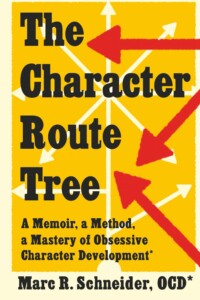
Title: The Character Route Tree: A Memoir, A Method, a Mastery of Obsessive Character Development
Author: Marc R. Schneider
Publisher: Giddoff Press
ISBN: 979-8218776916
Pages: 760
Genre: Memoirs / Self-Help / Compulsive Behavior
Interviewed by: Christina Avina
Author Interview: Marc R. Schneider
 PBR: What inspired you to write The Character Route Tree, and what motivated you to share your personal approach to character development with readers?
The inspiration came from realizing that character isn’t something you’re just born with; it’s something you build, mile by mile. I spent nearly 20 years coaching football, and I’ve always been obsessed with the sport. A football coach with OCD is both a workhorse and a racehorse. We are obsessive planners and executors of our craft.
I took that OCD into the coaching world and thought, “Wouldn’t it be something if we could be as obsessive about our personal mastery as we are about scouting reports, wins, and losses?” I wanted to create a scouting report for character development—the obsessive kind. The kind that wins.
I gravitated toward acronyms like I always have, and it hit me: F.O.O.T.B.A.L.L.—Focus On Obsessions That Build A Lasting Legacy. This is a “football book” that isn’t about football; it’s a disciplined deep dive into what it takes to move the chains of the mind. I felt motivated to share this because I’ve been at the “point of no return” too many times in my life. I wanted to show others that there is a systematic, coachable way to find your grip and change your trajectory. I didn’t want this to be preachy—I wanted it to be authentic, raw, and road-tested.
PBR: The book blends memoir with writing methodology. How did your personal experiences shape the character development techniques you discuss?
For the better part of my life, my obsession was a disorder I was trying to get a hold of. It was a constant battle involving therapy and medication, but writing was always my best therapy. The acronyms I’m known for didn’t start as a branding exercise; they started as a coping mechanism for my anxiety. They were the jigsaw pieces of a mind that was literally at war with itself.
I didn’t just invent these techniques; I grew into them. I had to. The Character Route Tree and The Obsession Progression were my ways of mapping out a “Software Update” for a system that was crashing. Those raw, sometimes ugly experiences of my life shaped the 9 Routes because they were the moments I lost my grip and had to find a systematic way to get it back. Each route became a lesson in becoming:
- The FLAT: Flat Out Determined. Show up for the quiet work when no one is watching.
- The SLANT: Slant to New Perspectives. Stop defending your view and start expanding it.
- The COMEBACK: Come Back Stronger. Recovery isn’t a return; it’s an evolution.
- The CURL: Curl Up Your Sleeves. Discipline is devotion; character is built in repetition.
- The OUT: Out on a Limb. Growth lives just beyond fear.
- The DIG: Dig Your Vibe. A slow unearthing of authenticity, not an echo of someone else.
- The CORNER: Corner the Market on Appreciation. Find gratitude when the stands are empty.
- The POST: Post a Flag of Leadership. Service over spotlight; the privilege of learning from mistakes.
- The GO: Go Be Somebody. Legacy is about being worth remembering.
To execute these routes, I developed The Obsession Progression—six mechanical components of personal growth: Stance, Start, Release, Stem, Depth, and Timing. I’m showing that these aren’t just theories. They are the road-tested disciplines I used to turn a disorder into a “Playbook” for a lasting legacy.
PBR: You describe your process as “obsessive character development.” What does that mean to you, and why do you believe such depth is important in storytelling?
To be clear, “Obsessive Character Development” is all about personal mastery. I am not concerned with developing characters for a novel; I am concerned with developing you, the reader. Character development, in this context, is a narrative that unfolds through nine specific lenses: tenacity, perspective, durability, discipline, faith, perseverance, dignity, leadership, and influence.
Because of my OCD, I can’t help but look at the minute details of the routes we run in our daily lives. Our life is our greatest story, yet most people stay at the surface. The deep dives are difficult, messy, and painful—so I set out to map something deeper for personal growth and self-improvement.
I had to be willing to expose the deepest and darkest parts of my own story to bring true depth to the narrative that others are currently writing for themselves. When you obsess over the right things, the routes become easier to run. Your life becomes—dare I say—easier to write, but more importantly, more interesting. You aren’t just telling a story; you are mastering the system that allows you to execute when the pressure is on.
PBR: Your book combines storytelling insights with practical guidance. Who did you primarily write this book for: aspiring writers, seasoned authors, or readers interested in the craft of storytelling?
I didn’t write this for people who want to put words on a page; I wrote it for people who want to put their lives in order. While I use the language of a “Route Tree” and storytelling, the “character” I am concerned with developing is you, the reader.
I wrote this book for:
- The Person at the Point of No Return: The one who feels like they are heading the wrong way and needs a systematic “software update” to find their grip again.
- The Relentless Mastery-Seeker: Anyone who is tired of surface-level self-help and wants to do the difficult, messy, and (perhaps) painful “deep dive” into their own personal narrative.
- The “Broken Hero”: Those who have experienced chaos and need a coach’s scouting report to turn their darkest chapters into a lasting legacy.
PBR: Were there any authors, mentors, or literary influences that shaped your philosophy on character development?
My philosophy wasn’t shaped in a library; it was forged in a huddle. In July of 2010, a nine-month quest led me to work for a lifetime idol with one of the most championed pedigrees in NFL history: Bill Curry. I was an unpaid 40-year-old recruiting and wide receiver intern on his inaugural staff at Georgia State, I didn’t just learn football; I honed character.
Coach Curry played for legends like Vince Lombardi and Don Shula, but his greatest impact on me was his ability to speak and share all that is truest in us—the good, the bad, and the ugly. He is an incomparable thinker who taught me that being a proactive and compassionate thinker is the worthiest pursuit of all.
His influence became the basis for my own coaching philosophy and the heart of The Character Route Tree’s A.C.R.O.N.Y.M.—A Coach’s Rationale On Nurturing Your Mindset. I took Coach Curry’s championship pedigree and combined it with my own obsessive need for structure to create a scouting report for the soul.
PBR: What was the most challenging part of writing this book?
The most challenging part was realizing that I couldn’t coach others on character until I did a deep, microscopic scout of my own. For the first four years, I was writing a standard self-help book. But after thirty years and five different therapists, it was “number six” who gave me the breakthrough. “Six” urged me to stop just writing a manual and start writing a memoir.
I spent the next two years tearing my life apart on the page. I had to revisit a toxic childhood, crippling anxiety, over a decade of self-harm, a suicide attempt, and the official diagnosis of obsessive-compulsive disorder at twenty-eight that made me feel broken.
The hardest part was being broken and realizing I couldn’t just “fix it” with a quick solution. I had to learn how to obsess over the right things to find order in the disorder. Writing this book became a healing exercise and literal “character development” for me. I had to go back and stand in my darkest chapters to ensure that the framework I was giving the reader—the 9 Routes—wasn’t just theory, but a road-tested survival guide.
PBR: What do you hope readers, especially writers take away from The Character Route Tree? First,
I want readers to obsess over the right things and to learn how to architect a better legacy. I hope they realize that healing starts with looking at your own story—even the darkest chapters—with total authenticity.
You don’t have to stay broken. By using the 9 Routes, you can find the grip to execute when life puts the pressure on. My goal is for every reader to shift their obsession from a disorder into not just a strength, but a superpower—moving from the exhaustion of pleasing people to the fulfillment of winning with people. I want them to walk away with a roadmap that proves you can find order in the disorder and create a life that is truly worth remembering.
PBR: Are you currently working on any new writing projects or continuing to expand the ideas presented in this book?
I am always writing. I said a lot in this book at 760 pages, so right now I’m spending my time promoting it and writing my newsletter, The ACRONYMOS Source: A Coach’s Rationale Obsessively Nurturing Your Mindset Offering Undefeated Support. It’s a short-form delivery of individual ACRONYMS you can act on immediately—the tactical tools from The Character Route Tree delivered straight to you. You can learn more at marcrschneider.com