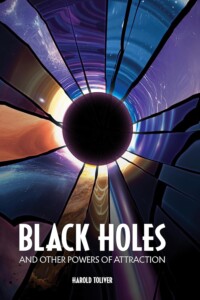
Title: Black Holes and Other Powers of Attraction
Author: Harold Toliver
Publisher: Bookside Press
ISBN: 978-1778838385
Pages: 112
Genre: Nonfiction / Politics & Social Sciences / Philosophy
Reviewer: Alyssa Avina
Pacific Book Review
If there was ever one topic more divisive or more debated amongst the human race, it must be the origins of the Universe. The divide stems from the need of some to find answers through faith and spirituality, while others seek more grounded, rooted scientific methods to explain the mysteries of the Universe. For centuries, competing faiths have been the bedrock of social and historical discussion around this topic, but as science has grown and advanced through the use of advanced technology, more people have begun to value the science of the Universe to obtain the answers they seek.
In author Harold Toliver’s Black Holes and Other Powers of Attraction, the author explores the differences between scientific reason and exploration with literary and spiritual texts that argue for a more human-centered experience. Through a series of essays, the author combines the works of religious texts and poets alike, and explores the science and evolution that provide answers to the questions posed by those works.
Thought-provoking, the author does a wonderful job of curating compelling scientific evidence and reasoning to explore powerful cosmic experiences. From the way light travels and behaves in space and how this compares to the way animals on Earth travel in straight lines, to the placement of the Universe and the celestial bodies making it up, this book does a great job of bringing scientific thesis and experimentation to the forefront and allows each essay to speak for itself. The author’s writing does a great job of conveying specific scientific knowledge while remaining accessible and easy to understand for everyday readers.
Readers who enjoy nonfiction, especially those that explore political and social sciences, philosophy, religion versus science, and the scientific method, will thoroughly enjoy this book. The author makes some great comparisons in this book for reference, from humanity going from exploring concepts for placement like Valhalla and Olympus to a more technology based mapping of the Universe through computing power, and the author’s use of both literature and history to explore mankind’s relationship to the world and the struggle to reconcile that with the scientific knowledge gained over the last several decades make this book so insightful and compelling to read.
Harold Toliver masterfully weaves together scientific wonder, philosophical reflection, and literary elegance to create a book that challenges readers to rethink the nature of attraction itself. A captivating read for curious minds and lifelong learners alike.