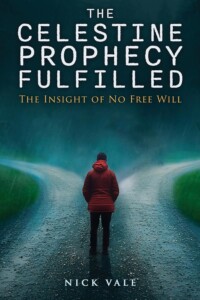
Title: The Celestine Prophecy Fulfilled (The Insight of No Free Will)
Author: Nick Vale
Publisher: Author’s Tranquility Press
ISBN: 978-1-966088-31-8
Pages: 151
Genre: Spirituality
Reviewer: Carol Davala
Pacific Book Review
James Redfield’s popular 1993 The Celestine Prophecy foretold that the world was on the verge of a huge spiritual breakthrough. Herein, with author Nick Vale’s recent The Celestine Prophecy Fulfilled (The Insight of No Free Will) the focus is on the premise that free will does not exist, said freedom is just an illusion, and such thought realizes the promise of a great metaphysical rising.
The book opens by posing the question “what does ‘Free Will’ mean to you?’, and “do you believe you have it?”. It goes on to define “free will” as your life being up to you and not predetermined, and that with “free will” you have free choice, i.e. free from prior causes, constraints, fate, or divine intervention. However, according to Vale, although we can do what we want, we cannot choose what we want in the first place. And, while we may select an option and act on our choice, there is always a cause/reason for our choice. The Celestine Prophecy Fulfilled also emphasizes that humans possess the intellectual capacity to comprehend that it is more logical that a human’s so-called free will is 100% causal and that all life is predetermined. The term “free” is rendered as confusing in that God gave man free will, yet as an all knowing and powerful entity, he already knows what each of us will do.
Ultimately Vale infers the Law of Causation creates fundamental vindication, thus we are not responsible for our actions. Here Vale indicates that the greatest gift of “no free will” is knowing our truest, deepest self is innocent. Vale goes on to suggest that society will be improved if “no free will” is implemented, resulting in less anxiety, guilt, disappointment, or blame. He does not foresee a breakdown of law and order in our society, as actions will still have pragmatic consequences.
While Vale’s writing is clear and intentional, the overall narrative often seems repetitious in its ongoing attempt to drive a point home. This is undoubtedly a thought-provoking work. Vale proposes that our lives follow a predetermined path, and ultimately free will does not exist.
While the book’s intentions are to build on themes introduced in Redfield’s renowned work, readers should realize that while The Celestine Prophecy Fulfilled is clearly an adventure into spiritual awakening, it was published as a work of fiction.
While Vale’s work is also a spiritual inquiry, his emphasis on the absence of free will is ultimately from his own perspective and may be at odds with the core beliefs that many adhere to. Nevertheless, it is a book that serves to make readers think and reflect on Vale’s precepts, as well as their own convictions. The Celestine Prophecy Fulfilled offers an intriguing perspective on the possibility that life unfolds according to a deeper order we may only gradually come to recognize.