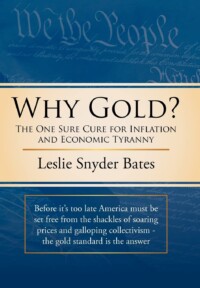
Title: Why Gold? The One Sure Cure for Inflation and Economic Tyranny
Author: Leslie Snyder Bates
Publisher: AuthorHouse
ISBN: 978-1-4490-3821-2
Pages: 162
Genre: Economics / History
Reviewer: Jason Lulos
Pacific Book Review
In Why Gold?, author Leslie Snyder Bates makes a compelling argument for the United States to return to the gold standard. But what is the gold standard and how does it differ from using paper money? Bates makes the distinctions clear. Using paper money under a national bank (the Federal Reserve) is a recipe for socialism, government overreach, and inflation. Using gold, under a free market, limits inflation and promotes individual economic freedom. This book is an enlightening explanation of how the pros of gold and the cons of paper money extend beyond economics.
Critics have called the gold standard a “barbaric relic.” Bates claims that the gold standard is still practical today. Using the gold standard would reduce inflation, give back economic freedom to the individual, create more government transparency, and could even lead to a decrease in war because of that transparency and economic stability. Printing money can offer a temporary solution, say, to fund a war, but the resulting inflation and depression are more destructive. To fund the Revolutionary War, the government printed paper money called “Continentals” and this resulted in severe inflation. This is where the phrase “not worth a Continental” comes from. Bates argues that this inflation prolonged and/or hurt the war effort, only to be saved by loans from France.
Bates asserts “. . . the right to own and use gold is the difference between freedom and slavery” (33), and “This country cannot remain free if the Federal Reserve is permitted to exist” (67). In short, the more the government controls, the less the individual has control over their own life choices. Soviet Socialism, Nazi Germany, and China under Mao have shown the ill effects of a complete socialist economy. Bates states that a capitalist system with some socialist interventions is not a useful compromise. It’s either a free market or it isn’t. When a federal bank confiscates gold or starts printing money, rights are infringed, the dollar is devalued, and inflation ensues. The federal bank is not subject to audit: there is no transparency. And under a federal bank, all banks can operate in unison. When all banks engage in irresponsible business practices, the entire national economy suffers. But with no central bank, under the gold standard, the laws of supply and demand and profit and loss will urge any bank that expands credit to reign in their practices, or they go out of business. This is one of the best arguments: that widespread inflation under a federal bank is always going to be more destructive than individual banks taking those risks themselves. This encourages good business practices and weeds out irresponsible borrowing and lending.
Bates also argues that the economy is simply too complex for the government to run. The government is not omniscient. A free market regulates itself. Using the gold standard discourages printing money: the road to inflation. Bates also argues against other social programs such as raising the minimum wage (which leads to unemployment) and bailing out companies “too big to fail.” Government intervention devalues the dollar. The gold standard is guided by the free market. Under a free market, the individual, not the government, controls their pursuit of happiness. Under this system, the individual is empowered and gets satisfaction from their own self-determination.
This book was first published in 1973. This 2008 edition has revisions and observations on the economy in that interim. Bates addresses arguments against the gold standard and ends the book with a practical solution for reintroducing the gold standard. This book is a great educational resource on the economic history of the United States. Regardless of your political leanings, if you’ve ever wondered just what the gold standard is and what the dangers of printing paper money are, Why Gold? is illuminating.
In Why Gold?, Leslie Snyder Bates provides a clear and accessible guide to understanding why gold has long been considered a hedge against economic instability. With practical insights and compelling reasoning, this book empowers readers to take control of their financial future with confidence.